

Introduction
Diastasis recti is the separation of the left and right rectus abdominis muscles along the mid‑line connective tissue (linea alba). During pregnancy the growing uterus and pregnancy‑related hormonal softening of the abdominal wall stretch this tissue, often creating a gap wider than two finger‑widths (≈2 cm). While a modest widening is normal in the third trimester, a persistent separation after birth can lead to a visible “pooch,” doming of the abdomen when the core contracts, low‑back discomfort, and weakened pelvic‑floor function. Why it matters fornew mothers? If the gap remains wide, the weakened core may contribute to urinary incontinence, constipation, hip‑pain, and even umbilical hernias, affecting daily activities and overall quality of life. Prevalence after pregnancy is high—about 60 % (six in ten) of women experience some degree of diastasis recti postpartum, and roughly 45 % still have a measurable gap at six months. Early identification and individualized, evidence‑based rehabilitation can reduce the separation, restore core stability, and support a pain‑free, active return to motherhood.
Diagnosis and Early Concerns
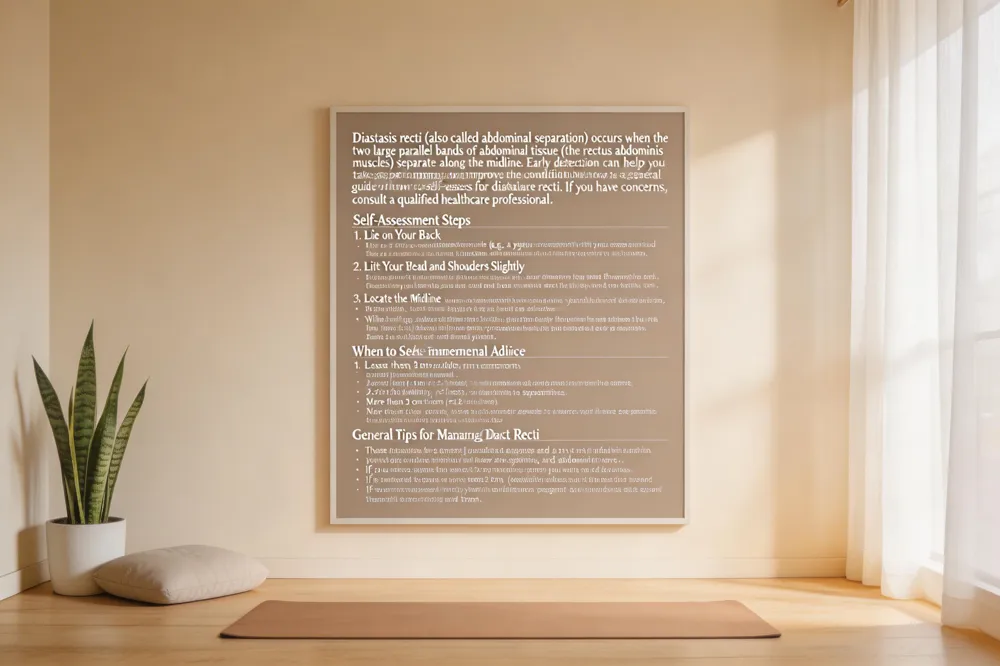 Self‑assessment is a useful first step. Lie on your back with knees bent, gently lift your head and shoulders, and place two fingers just above the belly button. If you feel a gap between the left and right rectus muscles that accommodates two finger‑widths (≈2 cm), seek professional evaluation. Clinicians confirm the diagnosis by palpating the midline at three points (2 cm above, at, and 2 cm below the umbilicus) and measuring the inter‑rectus distance (IRD) with finger‑widths, a measuring tape, or calipers; a gap > 2 cm is considered diastasis recti. Ultrasound can provide precise IRD values and rule out hernias when the exam is equivocal. A separation of 2 cm or more is not inherently dangerous, but persistent gaps can weaken core stability, leading to low‑back pain, pelvic‑floor dysfunction, and postural problems. Early detection—usually at the 6‑week postpartum visit—allows timely referral to a pelvic‑health physical therapist for a tailored rehabilitation program.
Severity, Symptoms, and Visual Guides
 Severe diastasis recti symptoms
A pronounced “pooch” or bulge appears in the lower abdomen, especially when you sit up, lift, or strain. The gap often exceeds 2 cm, causing persistent low‑back and pelvic pain, a soft “doming” sensation around the belly button, poor posture, and functional limits such as difficulty lifting a child or coughing. Constipation, urinary incontinence, and dyspareunia may accompany the weakness, affecting daily activities and confidence.
Diastasis recti in men
Although most common after pregnancy, men can develop diastasis from chronic abdominal pressure—heavy lifting, repeated straining, or rapid weight changes. Presentation mirrors women’s: a visible midline bulge, core instability, lower‑back discomfort, and trouble with trunk‑stabilizing tasks. A physical exam measuring >2 cm separation confirms the diagnosis. Treatment follows the same evidence‑based core‑rehabilitation program, emphasizing gentle transverse abdominis activation, postural correction, and progressive strengthening under therapist guidance.
Pictures of severe diastasis recti
Severe cases show a wide gap with a domed “pooch” extending several centimeters above and below the umbilicus. Clinical photographs reveal thinned linea alba and bulging abdominal wall during a head‑lift. High‑resolution ultrasound or MRI can illustrate the exact inter‑rectus distance, though these images are typically obtained in a medical setting. For visual reference, reputable medical sites (e.g., Cleveland Clinic) provide side‑by‑side illustrations of mild to severe diastasis.
Pregnancy, Postpartum Healing, and Timeline
 Before pregnancy the two rectus abdominis halves sit flush together with no measurable gap. In the third trimester hormonal relaxation and the expanding uterus stretch the linea alba, often creating a 1‑5 cm separation known as diastasis recti. After delivery many women experience a natural reduction of the gap within the first eight weeks, yet a noticeable separation can persist beyond the typical six‑week healing period, sometimes up to 12 months.
Diastasis recti before and after pregnancy: The gap develops as the abdominal wall stretches; without targeted rehab it may lead to back pain, core weakness, and pelvic‑floor dysfunction.
Diastasis recti postpartum: Up to 60 % of women show a bulging “pooch” and core instability. Gentle core activation, pelvic tilts, and modified planks can promote closing within 8‑12 weeks, while larger gaps often need a structured PT program.
How long postpartum can you heal diastasis recti? Most improvement occurs by 8 weeks; many achieve substantial closure by 6 months. Persistent gaps after six months merit a therapist‑guided plan, usually resolving by one year.
How to close diastasis recti at home: Start with diaphragmatic breathing and pelvic‑floor engagement, then progress to heel‑slides, dead‑bugs, and side‑planks while drawing the belly button toward the spine. Avoid traditional crunches and full planks until core stability is confirmed. Practice 3‑4 times weekly, increasing reps as the gap narrows.
Conservative Management and Long‑Term Fixes
 Gentle core activation is the foundation of diastasis‑recti rehab. A therapist begins with diaphragmatic breathing and a subtle abdominal draw‑in (transverse abdominis engagement) while the patient lies supine, teaching the deep core to fire without doming the midline.
From this base a progressive exercise program is introduced. Heel‑slides, modified dead‑bug, single‑leg raises and knee‑supported side‑planks are added in low‑impact positions, each movement performed slowly and with proper alignment before advancing to more functional drills such as modified planks or bird‑dog variations.
Biofeedback tools, real‑time ultrasound, or EMG help the patient visualize muscle recruitment, ensuring symmetric activation and preventing excessive intra‑abdominal pressure.
A women’s‑health physical therapist conducts the initial assessment, measures the inter‑rectus distance, designs the individualized progression, and integrates pelvic‑floor training, postural education and safe body mechanics.
How to fix diastasis recti years later: A thorough PT evaluation, graded core loading, biofeedback‑guided muscle re‑education, and, if the gap remains large, surgical referral for linea‑alba plication.
Diastasis recti exercises: Begin with diaphragmatic breathing and draw‑in, then heel‑slides, modified dead‑bug, knee‑supported side‑plank, progressing only when the abdomen stays flat.
Healing diastasis recti: Consistent, supervised PT using the above progression typically yields noticeable improvement within 3‑6 months, with maintenance exercises to prevent recurrence.
What does a women’s‑health PT do? They evaluate pelvic‑floor and core dysfunction, employ manual therapy, targeted deep‑core drills, biofeedback, and education to restore strength, coordination and functional confidence.
When Surgery Becomes an Option
 Indications for operative repair include a persistent diastasis recti gap larger than 5 cm after 6‑12 months of dedicated physical‑therapy, or significant functional problems such as chronic low‑back pain, core instability, or a pronounced "pooch" that does not improve with conservative care.
Laparoscopic versus open plication: Both techniques suture the rectus muscles together, but laparoscopic repair uses small incisions, less postoperative pain, and a quicker return to light activity, while open abdominoplasty provides direct visualization and may be combined with excess‑skin removal. The choice depends on gap size, surgeon expertise, and patient preferences.
Post‑operative rehab is essential. A skilled pelvic‑health physical therapist guides a staged program: protected core activation (first 2‑4 weeks), gradual re‑education of the transverse abdominis, and progressive functional strengthening. Most patients resume normal daily tasks by 4‑6 weeks and achieve full functional recovery by 3‑6 months when rehab is followed consistently.
Outcome expectations: Surgery can reduce the gap, improve core stability, and lessen back pain, but results vary. Maintaining a strong core and healthy lifestyle after surgery helps prevent recurrence.
Diastasis recti surgery – Reserved for gaps > 5 cm or disabling symptoms after a thorough 6‑12‑month PT trial; performed via laparoscopic or open plication; post‑op PT protects the repair and restores function; full recovery 3‑6 months.
Pictures of severe diastasis recti – Appear as a wide mid‑line gap with a prominent bulge extending above and below the belly button; clinical photos and ultrasound images illustrate the thinning of the linea alba. For visual references, consult reputable medical sources or schedule an in‑person evaluation.
Local Expertise and Career Opportunities in La Crosse
 O’Brien Physical Therapy – Located in La Crosse, O’Brien Physical Therapy and Wellness provides personalized, evidence‑based rehabilitation for orthopedic conditions, women’s health, and diastasis recti. The team uses manual therapy, dry needling, and strength‑conditioning in a wheelchair‑accessible space with flexible hours (7 a.m.–3 p.m.), emphasizing patient education and home‑program continuity.
Dynamic Physical Therapy – This clinic offers a comprehensive, evidence‑based approach that includes manual therapy, dry‑needling, pelvic‑health programs, vestibular/balance classes, Pilates‑based rehab, aquatic therapy, and cupping. Collaboration with O’Brien ensures a seamless continuum of care from evaluation to long‑term wellness.
Coulee Physical Therapy – Situated on Mormon Coulee Road, Coulee delivers orthopedic and sports rehab with dry needling, Graston, vestibular work, and cupping. With 25 + years of experience and a 98 % satisfaction rate, it partners with local physicians and O’Brien for coordinated care.
Burkhardt Physical Therapy Center – Burkhardt provides individualized manual therapy, gait analysis, and post‑operative rehab. Their programs feature shoulder‑strengthening routines, “Prayer Stretch” protocols, and targeted pectoralis/occiput stretches, all grounded in patient education.
Career Opportunities – O’Brien frequently hires PTs, PTAs, and massage therapists. Benefits include a supportive environment, CEU support, and flexible scheduling. Applicants apply via the clinic’s website or email hr@obrienphysicaltherapy.net.
Onalaska Services – Residents of Onalaska receive the same evidence‑based care for diastasis recti, sports injuries, and women’s health as offered in La Crosse.
Red Flags and When to Seek Immediate Care
 While most diastasis recti symptoms—bulging, low‑back ache, or core weakness—improve with guided therapy, certain warning signs signal a more serious problem. Look out for sudden, severe abdominal pain, a rapidly enlarging bulge, loss of bowel or bladder control, fever, unexplained weight loss, or any new numbness or tingling in the abdomen or groin. These red‑flag symptoms may indicate an associated hernia, infection, or neurologic issue that requires urgent medical evaluation. If any of these appear, contact your physical therapist immediately; they will arrange a prompt referral to a physician or surgeon for imaging and comprehensive assessment. Safety is paramount—never ignore worsening pain or functional loss, and schedule a professional evaluation as soon as red flags emerge.
What is a red flag in physical therapy? Red flags are warning signs that suggest a condition may be serious enough to require medical evaluation beyond physical therapy. Examples include unexplained weight loss, night pain, loss of bowel or bladder control, fever, and a history of cancer. When a red flag is identified, the therapist refers the patient to a physician for further assessment.
Conclusion
Diastasis recti is diagnosed by a simple finger‑width test or, when needed, ultrasound to confirm an inter‑rectus distance greater than 2 cm. First‑line treatment is a structured physical‑therapy program that activates the transverse abdominis, teaches diaphragmatic breathing, and progresses safely from gentle bracing to functional core stabilizers, while avoiding high‑intra‑abdominal‑pressure moves. Most women notice measurable gap reduction within 6‑12 weeks of consistent therapy, with full functional recovery often achieved by 6‑12 months, depending on initial severity and adherence. Early referral to a pelvic‑health PT accelerates healing, reduces low‑back and pelvic‑floor complaints, and prevents chronic issues such as hernias or persistent bulging. If you are in the La Crosse area, our specialists at O’Brien Physical Therapy, Vitality Women’s Physical Therapy, and the Mayo Clinic Health System can provide personalized assessment, evidence‑based exercise protocols, and supportive education to help you regain core strength and confidence. Schedule an evaluation today and take the first step toward a stronger, pain‑free future.