

Introduction to Low‑Load Blood Flow Restriction
Low‑load blood‑flow‑restriction (BFR) training applies a calibrated pneumatic cuff proximally on a limb to partially impede venous outflow while preserving arterial inflow, creating a hypoxic, metabolically stressful environment during light‑intensity exercise (20‑30% 1RM). The technique originated in Japan in the 1960s as KAATSU training and has since been refined and adopted by orthopedic, sports‑medicine, and physical‑therapy professionals worldwide. Because it elicits hypertrophy and strength gains comparable to traditional high‑load resistance training without heavy mechanical stress, low‑load BFR is especially valuable for post‑operative patients, individuals with joint pain, and athletes seeking to maintain performance while minimizing injury risk. This patient‑centered approach expands rehabilitation options and supports faster, pain‑free return to activity.
Physiological Foundations of Low‑Load BFR
 Low‑load blood‑flow‑restriction (BFR) training works by creating a hypoxic, metabolically stressed environment in the working muscle. Metabolic stress and lactate accumulation occur because venous outflow is partially blocked while arterial inflow continues, leading to high lactate and inorganic‑phosphate levels that signal anabolic pathways. This stress, coupled with cellular swelling, stretches muscle fibers and activates satellite cells, providing the cellular substrate for new protein synthesis.
The metabolic milieu triggers the mTOR signaling pathway, a central regulator of muscle protein synthesis, and also promotes early recruitment of fast‑twitch (type II) fibers even at loads of only 20‑30 % of 1RM. This recruitment pattern mimics high‑load resistance training, allowing comparable hypertrophy and strength gains.
Systemically, BFR elicits large spikes in growth hormone (GH) and insulin‑like growth factor‑1 (IGF‑1), further supporting anabolic remodeling. Repeated sessions also stimulate vascular and angiogenic adaptations, enhancing capillary density and blood‑flow delivery to the muscle.
What are the benefits of BFR training? BFR enables patients to build muscle strength and size with light loads, reducing joint stress and protecting surgical repairs or painful joints. The combined metabolic, hormonal, and cellular responses accelerate hypertrophy, improve aerobic capacity, and shorten post‑operative recovery while minimizing atrophy, making it a safe, evidence‑based tool for a broad range of individuals seeking pain‑free, functional improvement.
Standard BFR Protocols and Exercise Prescription
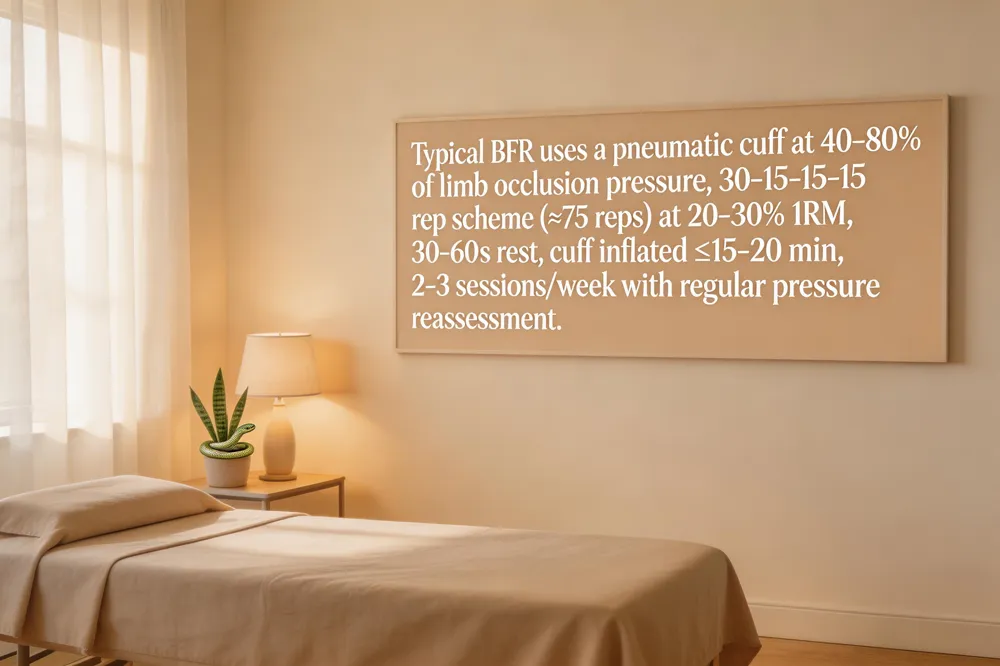 Low‑load blood‑flow restriction (BFR) training uses a pneumatic cuff inflated to 40‑80 % of the individual’s limb occlusion pressure (LOP). Cuff width matters; wider cuffs (10‑12 cm) require lower pressures to achieve the same occlusion and reduce discomfort, while narrower elastic bands need higher pressures. LOP should be measured in the exercise position with a Doppler probe or calibrated device, then 40‑60 % of LOP is used for the upper limb and 60‑80 % for the lower limb.
The typical set‑rep scheme is 30‑15‑15‑15 repetitions (≈75 reps total) per exercise, performed at 20‑30 % of one‑repetition maximum (1RM). Rest intervals of 30‑60 seconds are kept between sets, and the cuff remains inflated throughout the session. Total occlusion time per exercise should not exceed 10‑15 minutes; if the overall session is longer, the cuff can be briefly deflated for a minute before re‑inflating.
What is the typical BFR protocol for a session? A standard session inflates the cuff to 40‑80 % of LOP, places it proximally on the limb, and follows the 30‑15‑15‑15 rep pattern with 30‑60 seconds rest between sets. The cuff stays inflated for no more than 15‑20 minutes, and the protocol is repeated 2‑3 times per week, allowing regular reassessment of pressure, load, and patient tolerance.
Frequency, Duration, and Safety Guidelines
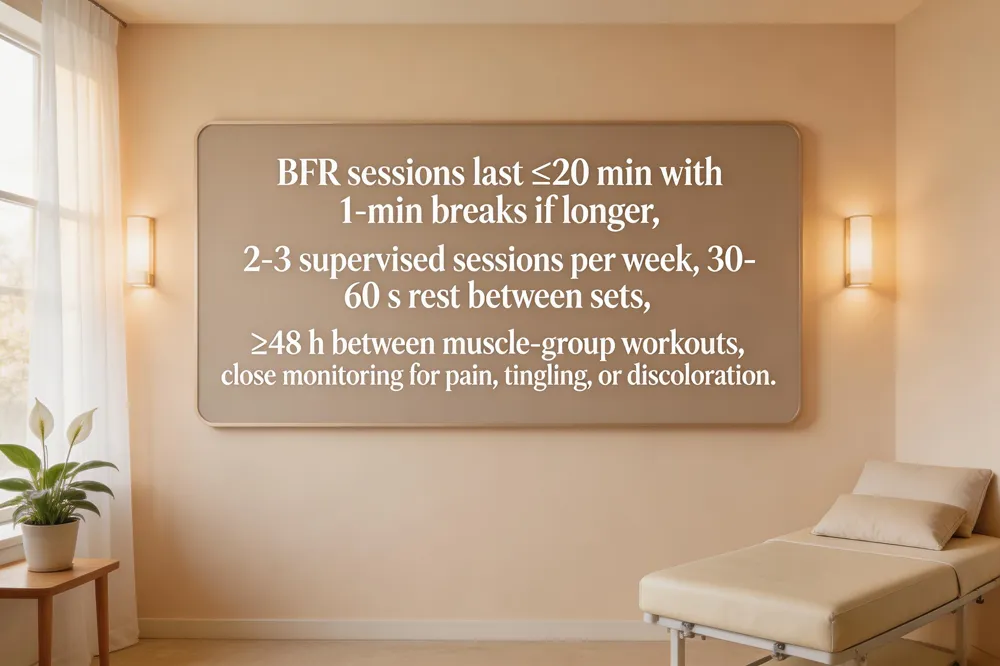 Low‑load blood‑flow‑restriction (BFR) training is most effective when the cuff is applied for short, controlled periods. Individual protocols allow up to 5 set hour in a clinical setting, allowing time limitation pressure (inflated for sets, 15‑15‑15 repetitions) keeps total occlusion well under the 15‑20‑minute safety window. If your workout exceeds 20 minutes, deflate the cuff for about a minute to restore normal circulation before continuing.
Weekly frequency – Most evidence supports 2‑3 supervised BFR sessions per week. This cadence allows enough stimulus for hypertrophy and strength while providing adequate recovery, especially for post‑operative or pain‑limited patients. Beginners may start with two sessions and progress to three as tolerated.
Rest intervals – Between sets, allow 30‑60 seconds of rest while the cuff remains inflated; between exercise sessions, provide at least 48 hours before targeting the same muscle group. This pattern limits cumulative ischemic stress.
Monitoring – During and after each set, watch for excessive pain, tingling, numbness, or skin discoloration. Any of these signs should prompt immediate cuff deflation and cessation of the exercise.
FAQs
- How long can you leave BFR on? Keep the cuff inflated for no more than 20 minutes per session; short breaks of 1 minute between sets help prevent prolonged ischemia.
- How many times a week should you do BFR training? Two to three sessions per week is optimal for strength and hypertrophy, with a gradual increase as individual tolerance improves.
Home Implementation and Patient Education
 Therapist‑prescribed elastic bands or pneumatic cuffs can be used safely at home once a qualified clinician has measured your limb occlusion pressure and selected the appropriate cuff width. The therapist will show you how to place the cuff proximally on the upper arm or thigh, tighten it to 40‑80 % of your individual arterial occlusion pressure, and confirm that arterial flow remains while venous return is partially restricted. Low‑load exercises such as body‑weight squats, seated leg extensions, light dumbbell curls, or standing calf raises are ideal for home use; the classic 30‑15‑15‑15 rep scheme (≈75 repetitions) with 30‑60 seconds rest between sets provides sufficient metabolic stress without heavy loading. While training, monitor for any excessive pain, numbness, tingling, or swelling; if any of these symptoms appear, release the cuff immediately and contact your therapist. Consistent self‑monitoring and adherence to the prescribed pressure and exercise protocol enable you to gain strength and muscle size while protecting joints and promoting a pain‑free return to daily activities.
Insurance, Coverage, and Clinical Integration
 Blood‑flow‑restriction (BFR) therapy is usually billed as part of a standard physical‑therapy visit rather than as a separate line item. The most common CPT codes are 97110 (therapeutic exercises), 97112 (neuromuscular re‑education) and 97140 (manual therapy) when BFR is incorporated into those services. A physician’s order or a documented medical‑necessity note is often required, especially for insurers that demand proof that BFR is appropriate for the patient’s diagnosis (e.g., post‑operative ACL reconstruction or osteoarthritis). Our clinic’s staff assists patients by reviewing their plan, submitting the appropriate CPT codes, and providing any supplemental documentation the payer requests. If a plan has specific limitations, we inform the patient upfront, help obtain the required physician order, and discuss any potential out‑of‑pocket costs. In short, BFR is typically covered as part of a PT session, but verification with the insurer and clinic support are essential.
Contraindications, Side Effects, and Patient Screening
 Absolute and Relative Contra‑indications
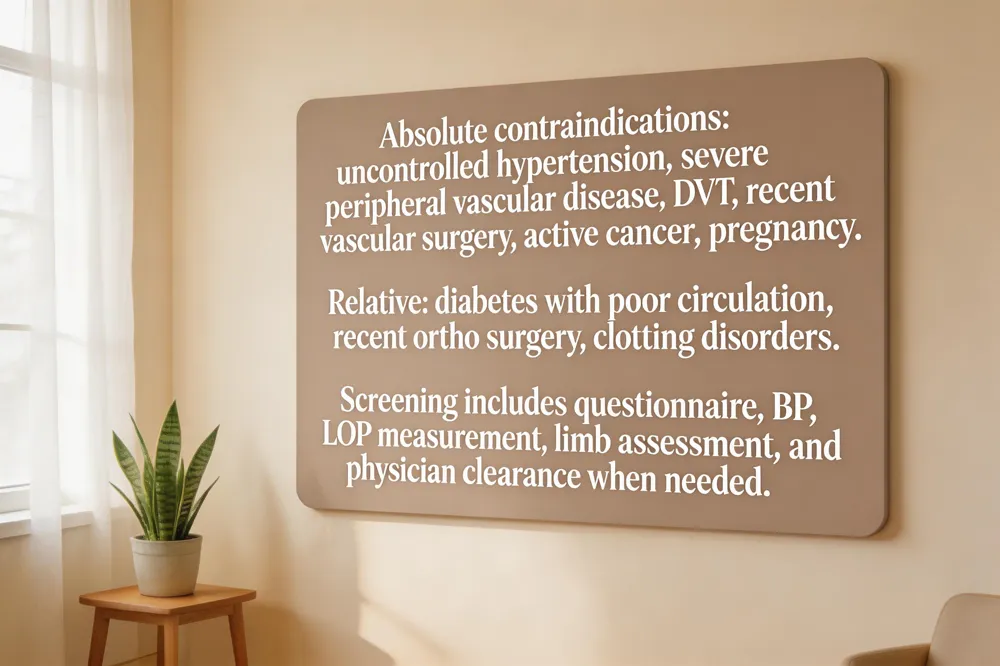
Absolute contraindications include uncontrolled hypertension (systolic ≥ 180 mmHg), severe peripheral vascular disease, active deep‑vein thrombosis, recent graft or vascular surgery, active cancer, and pregnancy. Relative contraindications—requiring physician clearance—are diabetes with poor circulation, recent orthopedic surgery (< 12 weeks), clotting disorders, and chronic kidney disease. Our therapists conduct a thorough medical‑history review to identify any of these risk factors before BFR is prescribed.
Common Mild Side Effects & Management
When applied correctly, most patients feel only a temporary tightness or pressure, light tingling, mild discomfort, or occasional bruising if pressure is excessive. Swelling, transient numbness, or brief light‑headedness may also occur. To manage these sensations, we keep cuff pressure within 40‑80 % of the individual’s limb occlusion pressure, limit inflation time to 15‑20 minutes per session, and provide 30‑60 second rest intervals. Any discomfort that persists beyond the session should be reported immediately.
Screening Process Before Initiating BFR
- Detailed health questionnaire (including cardiovascular, vascular, and oncologic history).
- Blood pressure and limb‑occlusion‑pressure measurement with a Doppler or calibrated device.
- Physical assessment of limb circumference, skin integrity, and nerve sensation.
- Physician clearance when any relative contraindication is present.
When to Discontinue BFR Immediately
Stop the session if the patient experiences severe pain, marked numbness, discoloration, dizziness, or signs of vascular compromise (e.g., rapid swelling). The therapist will then reassess cuff pressure, placement, and overall suitability for BFR.
FAQ
- Who should avoid BFR training? Individuals with uncontrolled cardiovascular disease, clotting disorders, a history of deep‑vein thrombosis, active cancer, severe peripheral vascular disease, or who are pregnant should not use BFR. Our clinician will verify eligibility during screening.
- What are the potential side effects of BFR training? Most side effects are mild and temporary—tightness, tingling, mild discomfort, bruising, or brief swelling. Serious events are rare when protocols are followed and monitoring is continuous.
Results Timeline and Clinical Outcomes
 How long does it take to see results from BFR training?
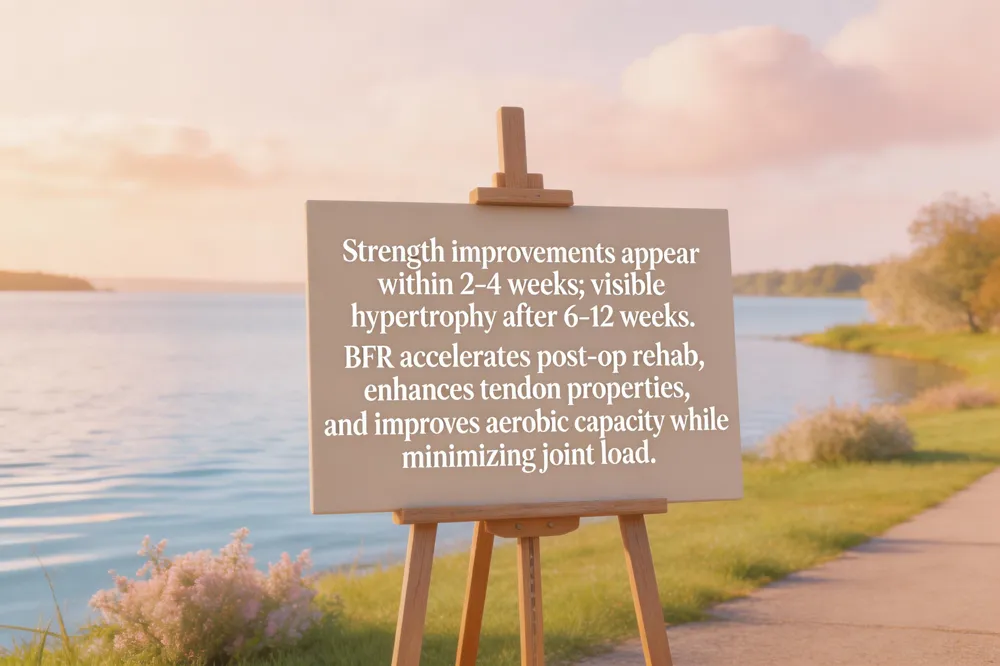
Most patients notice strength gains within the first 2–4 weeks of a regular blood‑flow restriction (BFR) program. The low‑load, high‑repetition scheme (20‑30 % of 1RM, 30‑15‑15‑15 reps) quickly activates motor units and creates metabolic stress, leading to early neural adaptations. Visible muscle hypertrophy generally follows a slightly longer course, appearing after 6‑12 weeks of consistent training, although modest size increases have been reported as early as 4 weeks when cuff pressure is properly individualized (40‑80 % of limb occlusion pressure) and sessions are performed 2‑3 times per week.
What is blood flow restriction training in physical therapy?
BFR training is a therapeutic modality that places a pneumatic cuff proximally on a limb to partially restrict arterial inflow while fully occluding venous return during exercise. This creates a hypoxic environment that amplifies anabolic signaling (mTOR, growth hormone, IGF‑1) and fast‑twitch fiber recruitment, allowing low‑load resistance (15‑30 % 1RM) to produce strength and hypertrophy comparable to traditional high‑load training (≥70 % 1RM). Because mechanical stress is minimal, BFR is ideal for post‑operative and pain‑limited patients, preserving muscle mass while protecting healing tissues.
Functional improvements for post‑operative patients
Clinical studies indicate that BFR can accelerate postoperative rehabilitation, particularly after anterior cruciate ligament reconstruction and total knee arthroplasty, often reducing pain scores and joint swelling. Patients typically regain functional tasks such as sit‑to‑stand and gait within 4‑6 weeks, with earlier return‑to‑play timelines compared to conventional rehab alone.
Research on tendon adaptations and aerobic capacity
Low‑load BFR can increase tendon cross‑sectional area and stiffness after 8‑14 weeks of training, matching high‑load training effects. When combined with low‑intensity cycling or walking, BFR also improves aerobic capacity (VO₂max) and peripheral oxygen extraction, offering cardiovascular benefits without excessive joint loading.
Putting It All Together for La Crosse Patients
Extensive research shows that low‑load blood‑flow‑restriction (BFR) training at 20‑30 % of 1RM produces muscle hypertrophy, strength, and endurance gains comparable to traditional high‑load resistance (70‑80 % 1RM). Meta‑analyses report large effect sizes for strength (0.74‑1.03) and endurance (≈1.4), and clinical trials demonstrate accelerated recovery after ACL reconstruction, knee arthroplasty, and rotator‑cuff repair. At our La Crosse clinic, certified therapists first screen for contraindications, then determine each patient’s limb occlusion pressure with a Doppler probe. Standard protocols use four sets (30‑15‑15‑15 reps) with 30‑60 second rests, cuff pressures set at 40‑80 % of the individual’s arterial occlusion pressure, and total occlusion time limited to 15‑20 minutes. We monitor pain, numbness, and discoloration throughout each session. If you have joint pain, post‑operative restrictions, or want to preserve muscle while staying active, ask your therapist whether BFR is right for you—it may be the key to a faster, pain‑free return to the activities you love.